
The SEMA Show takes place November 3 to 6, 2026, at the Las Vegas Convention Center. It is the automotive aftermarket industry’s biggest annual gathering, and it fills the building and the surrounding lots with product displays, custom vehicles, and buyers who come ready to place orders.
For exhibitors, SEMA is less a standard trade show and more a small city. The show organizers report roughly 1.1 million square feet of indoor exhibit space and about 1 million square feet outdoors, and the floor was nearly sold out months before opening. That scale shapes almost every decision, from booth size to freight timing to how you get noticed in a crowded aisle.
This guide covers the dates, the venue, the booth rules, and the planning details that matter most if you are exhibiting at SEMA 2026.
SEMA Show 2026 at a Glance
- Dates: Tuesday, November 3 to Friday, November 6, 2026
- Venue: Las Vegas Convention Center, 3150 Paradise Road, Las Vegas, NV 89109 (some designated areas of the Westgate Las Vegas Resort & Casino are also part of the show site)
- Show hours: 9:00 AM to 5:00 PM Tuesday through Thursday, and 9:00 AM to 4:00 PM on Friday
- Exhibitor early entry: Exhibitors may enter the halls at 7:00 AM before opening each show day
- Audience: Trade only, with public access on Friday, November 6 only (SEMA Fest returns the same day)
- Minimum age: No one under 16 is allowed in the show, including during move-in and move-out
The 2025 show drew 131,942 attendees and 2,283 exhibitors from 140 countries, including 500 first-time exhibiting brands. Organizers say 2026 is tracking strong, with more than 2,000 companies already committed to the floor plan.
Why SEMA Is Different From Other Las Vegas Shows
Most trade shows are won in the booth. SEMA is won in the booth and in the parking lot. Feature vehicles are placed throughout the Convention Center, including in Silver Drive, Silver Lot, Diamond Lot, Blue Lot, and the lobbies of each hall, and they act as extensions of exhibitor booths.
That changes what attendees expect. Buyers, builders, and media walk the floor looking for new products, and many of them are scanning products through the show app. A booth that photographs well, tells a clear product story, and gives builders something to touch will outperform a larger booth with no clear focus.
The program around the floor adds traffic you can plan around:
- New Products Showcase: A major draw in the Lower South Hall, with thousands of new products on display
- SEMA Battle of the Builders: Held in the Central Hall, with competition classes that now include a Bike Builders Shootout
- SEMA FutureTech Studio: A Central Hall area focused on EVs, future propulsion, automation, and smart manufacturing
- Expanded Powersports, SxS and Lifestyle section: Anchored in the West Hall, with access to adjacent parking lots for outdoor demos
- Collision Repair Stage: In the Upper South Hall, with hands-on demos
- SEMA Central: A show hub in the Grand Lobby with vehicle builds and stage interviews
The show’s feature listings are still being updated for 2026, so confirm booth numbers and locations against the current floor plan before you build your show-week schedule.
Getting Around the LVCC
SEMA uses the North, Central, South, and West Halls plus outdoor lots. The campus has been newly renovated, and the show’s own materials point to a more modern layout than past years.
For exhibitors, the practical takeaways are simple. Walking distances between halls are real, so schedule meetings with travel time in mind. Staff your booth for the full show day, since SEMA requires booths to be staffed during all show hours. And if your best customers are likely to find you through a specific section (powersports, trucks and off-road, collision repair, tools, wheels and tires), make sure your booth graphics make that category obvious from the aisle.
Key Dates and Move-In Schedule
SEMA has a long move-in window, but your own slot depends on your assigned freight target time. Here are the official exhibitor move-in hours:
- Thursday, October 29: 7:00 AM to 6:00 PM
- Friday, October 30: 7:00 AM to 8:00 PM
- Saturday, October 31: 7:00 AM to 8:00 PM
- Sunday, November 1: 7:00 AM to 8:00 PM
- Monday, November 2: 7:00 AM to 10:00 PM
Two deadlines matter most. All displays must be in place by 3:00 PM on Monday, November 2, with cartons, refuse, and empty crates cleared from the aisles. If installation has not started by that time, show management and the official contractor can erect the exhibit and bill you for it. Space that is not claimed and occupied by that time can also be reassigned.
Exhibitor-appointed contractors may enter at 7:30 AM on move-in days with approved wristbands. Exhibitor registration runs ahead of the show, with exhibitor-only hours on October 29 through 31, and general registration hours starting Sunday, November 1.
Booth Types and Display Rules
SEMA’s display regulations follow standard industry configurations, but the limits are specific. Build your design around them from day one.
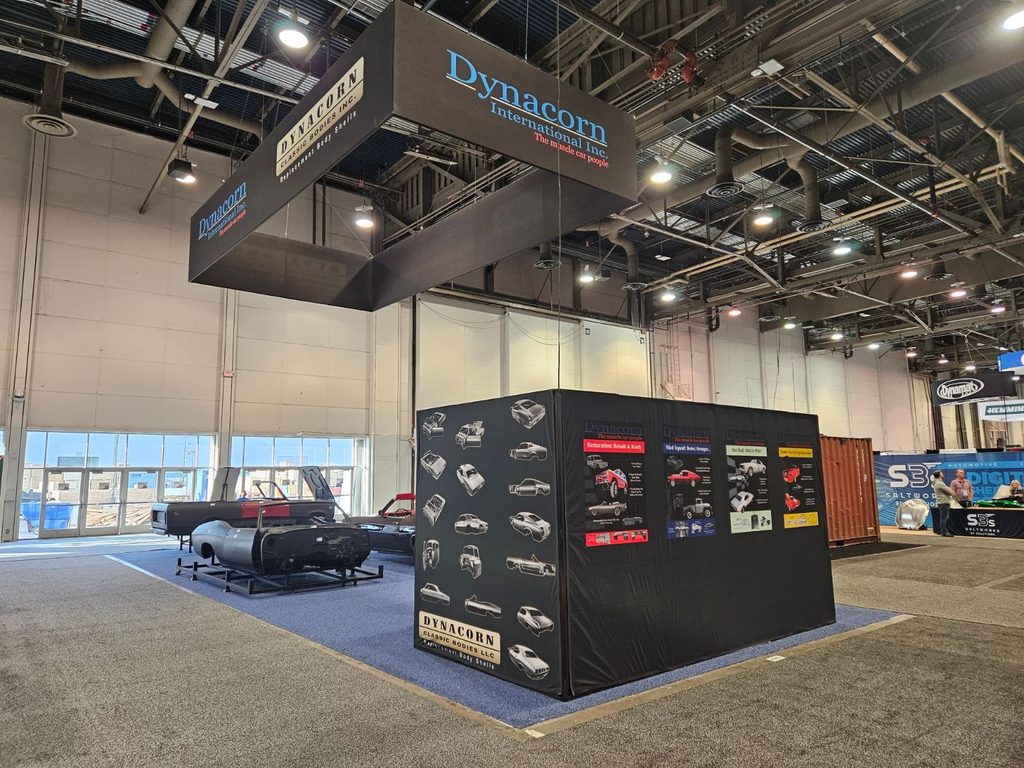
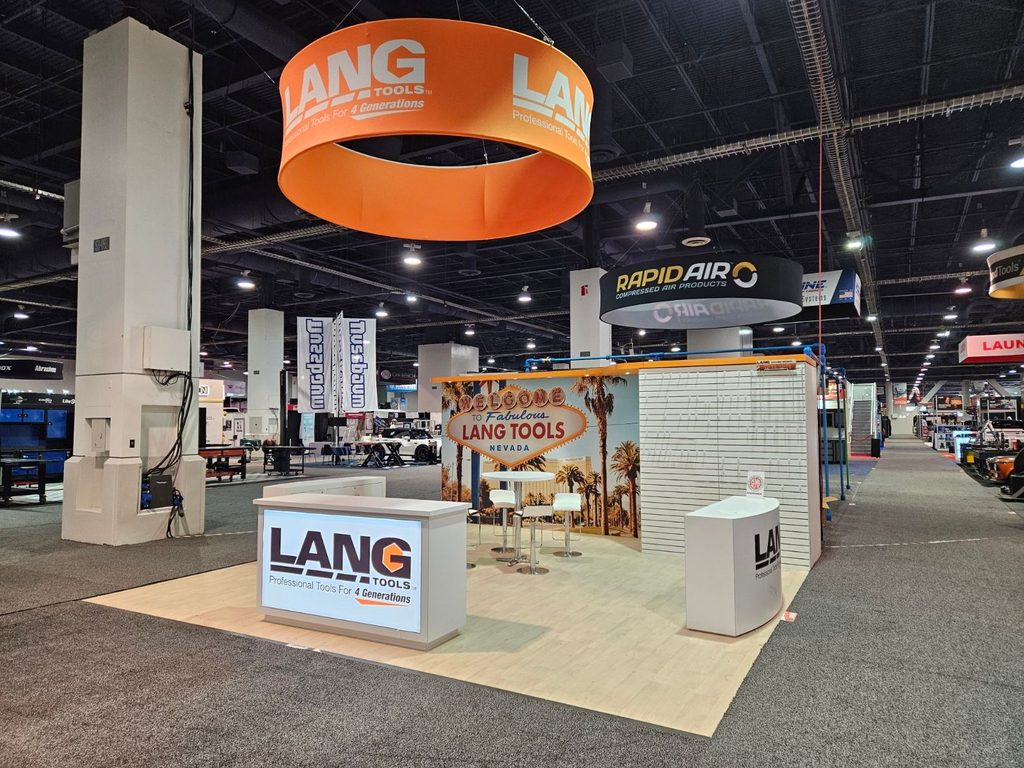
- Linear (inline) booths: 8 feet 3 inches maximum height. Within 5 feet of the aisle and 10 feet of a neighboring booth, nothing can exceed 4 feet. No hanging signs.
- Perimeter booths: 12 feet maximum height, with the same 4-foot line-of-sight rule near aisles and neighbors. Hanging signs are allowed, up to 12 feet high, and at least 5 feet from the aisle.
- Peninsula booths: Four or more 10 by 10 spaces back to back, with up to 16 feet of height and a full back wall allowed.
- Island booths: At least 400 square feet, surrounded by aisles, with up to 16 feet of height.
Hanging signs over peninsulas and islands can hang at any height, but the sign itself cannot be taller than 8 feet and must be finished on all sides. Signage facing a neighboring booth above 8 feet must sit at least 10 feet away from that neighbor.
Rules That Catch Exhibitors Off Guard
- Flooring is your responsibility. Show management provides aisle carpet only, so your booth space needs its own flooring.
- No fog, smoke, water, or steam machines. Balloons are limited, and they cannot be used for giveaways or sale.
- Noise caps at 85 decibels. Repeated violations can lead to your sound system being disconnected.
- Nothing attaches to the building. No bolts, hooks, decals, or adhesives on walls, columns, or floors.
- Finished sides matter. Any open or unfinished side that looks unsightly must be covered, and peninsulas and islands need a finished back wall.
- Electrical must be code-compliant. Wiring must be three-wire grounded, and cube taps are prohibited.
- Orders only, not on-site sales. Exhibitors may take orders for future delivery but cannot sell product for delivery at the show without written approval.
- Brand limits apply. Products and branding from non-exhibiting companies are restricted in booths and on vehicles.
Vehicles in Your Booth
If a vehicle is part of your display, plan for the rules early. Display vehicles must have battery cables disconnected and taped (or a battery cutoff switch kept off), alarms deactivated, fuel tanks no more than one quarter full or 5 gallons, and filler caps locked or sealed. Vehicles can occupy no more than 80 percent of the contracted space, must sit 10 inches back from the aisle, and cannot be started or moved once placed without show management approval. Fueling and battery charging inside the building are prohibited.
Larger and Multi-Level Builds
Booths of 400 square feet or more, and all multi-level exhibits, required design notification and renderings by September 4, 2026. Contractors building structures were required to submit booth plans to show operations by October 2, 2026. Occupied upper decks need a wet-stamped plan from a structural engineer registered in Nevada. Those deadlines have passed for most exhibitors, so if your paperwork is still open, contact SEMA show management right away.
Choosing a Booth Format for SEMA
SEMA exhibitors range from small accessory brands in a single inline space to major manufacturers with large islands and multiple feature vehicles. A few patterns hold up across the show:
- Product-first brands often do well in a 10 by 20 or 10 by 30 inline layout with clear product display and a defined meeting area.
- Vehicle-supported brands need room to work. A 20 by 20 booth rental gives you a footprint where a vehicle, product display, and conversation space can coexist without crowding the aisle.
- Large manufacturers and builders often move into custom booth builds that integrate vehicle platforms, lighting, storage, and hosting areas into one design.
Whatever you choose, remember that the first few feet from the aisle are limited to 4 feet in height for linear and perimeter booths. Your strongest graphics and product need to work within that line of sight, with taller messaging pushed back toward the rear wall.
Graphics deserve the same attention. Attendees at SEMA are product people, and they notice color accuracy and print quality. Work with a graphics and printing partner early, and build versions sized for backwalls, product signage, and any approved hanging signs.
Freight, Labor, and On-Site Logistics
SEMA’s official service contractor is Freeman, and it handles material handling during move-in and move-out. Exhibitors are assigned freight target times, and missing your slot can result in off-target fees. Target times are posted in the Exhibitor Service Manual, so check yours as soon as possible.
A few labor details are worth planning around:
- Company staff can set up a booth that can be completed without saws, pipe wrenches, or power tools.
- Installation work that requires standing on a ladder above 30 inches is not allowed for exhibitor staff.
- Work such as floor covering, signs hung from the ceiling, and platform erection falls under union labor jurisdiction when done by anyone other than full-time company personnel.
- Exhibitors can hand carry freight only if no material handling equipment is used.
Insurance is also strictly enforced. Exhibitors and their contractors must carry general liability coverage, and extra coverage applies for activities such as welding, driving demos, or operating a vehicle in the facility. Certificates were due 30 days before move-in.
Show Week Strategy
Because attendance is so broad, the best exhibitors treat SEMA as a series of focused conversations rather than a single flow of foot traffic.
Schedule key customer meetings before the show, position staff throughout the booth instead of behind tables, and plan product demos around peak floor hours. Keep in mind that exhibitors may not host buyer events off the show floor during exhibit hours without written approval. Off-site hospitality functions cannot open before 6:00 PM on show days, and hospitality inside the Convention Center can start at 5:00 PM.
SEMA Fest on Friday, November 6 extends the week into a public-facing evening of motorsports, music, and car culture. If your brand sells to enthusiasts as well as trade buyers, it is worth thinking about how your booth messaging works for both audiences on the final day.
Teardown and Move-Out
Move-out begins at 4:00 PM on Friday, November 6. Product and equipment cannot be removed between 1:00 PM and 4:00 PM on Friday, and starting teardown before the official closing time can result in a $500 fine and loss of seniority points.
Plan the details before you arrive. Stage packing materials, confirm your carrier and paperwork in writing, and assign one person to own teardown. All outbound freight must be ready by 12:00 PM on Sunday, November 8, and your preferred carrier must check in by 9:00 AM that day, or the official contractor will handle the freight at your expense.
How Prime Exhibits Supports Exhibitors at SEMA
Prime Exhibits is based in Las Vegas and has built booths for SEMA exhibitors before, including 20 by 20 and 20 by 50 displays at SEMA 2024. That local experience matters at a show where timing, rules, and freight windows leave little room for surprises.
If you are exhibiting at SEMA, here is where we can help:
- Exhibit design that works within SEMA’s height, line-of-sight, and vehicle regulations
- Planning and logistics support, from freight coordination to installation and on-site supervision
- Shipping and storage in Las Vegas, so your booth stays local between shows instead of making another cross-country trip (SEMA returns to Las Vegas November 2 to 5, 2027)
If you are still sorting out what your booth needs, a quick conversation with our team can save you time before move-in.
FAQs
When and where is the SEMA Show 2026?
The SEMA Show runs November 3 to 6, 2026, at the Las Vegas Convention Center at 3150 Paradise Road in Las Vegas. Some designated areas of the Westgate Las Vegas Resort & Casino are also part of the show site.
What are the SEMA Show 2026 hours?
The show is open from 9:00 AM to 5:00 PM Tuesday through Thursday, and 9:00 AM to 4:00 PM on Friday, November 6. Exhibitors may enter the halls at 7:00 AM before opening each day.
When can exhibitors move in?
Official exhibitor move-in runs from Thursday, October 29 through Monday, November 2, 2026. All displays must be in place by 3:00 PM on November 2. Your specific freight target time is listed in the Exhibitor Service Manual.
When does move-out start?
Move-out begins at 4:00 PM on Friday, November 6. Exhibitors cannot start tearing down before the official closing time, and product removal is not allowed between 1:00 PM and 4:00 PM that day.
Is the SEMA Show open to the public?
SEMA is a trade-only event, with public access on Friday, November 6 only. No one under 16 is allowed in the show, including during move-in and move-out.
What are the booth height limits?
Linear booths are limited to 8 feet 3 inches, perimeter booths to 12 feet, and peninsula and island booths to 16 feet. In linear and perimeter booths, anything within 5 feet of the aisle or 10 feet of a neighboring booth is limited to 4 feet in height.
Can I display a vehicle in my booth?
Yes, as long as it meets the rules. Vehicles must have battery cables disconnected, alarms deactivated, and fuel at a quarter tank or 5 gallons (whichever is less). They can take up no more than 80 percent of your space and must sit 10 inches back from the aisle.
Do I need to provide my own booth flooring?
Yes. Show management provides aisle carpet only, so booth carpet or floor covering is required in your space.
Can I sell products on the show floor?
Not without written approval from show management. Exhibitors may take orders for future delivery, and product inventory in the booth should be limited to what is needed for display.
How much does it cost to exhibit at SEMA?
Booth space is priced per square foot, at $24.95 for SEMA or TIA members and $39.95 for non-members, with additional fees for island and peninsula configurations. The floor was nearly sold out months ahead of the show, so check with show management about any remaining availability.